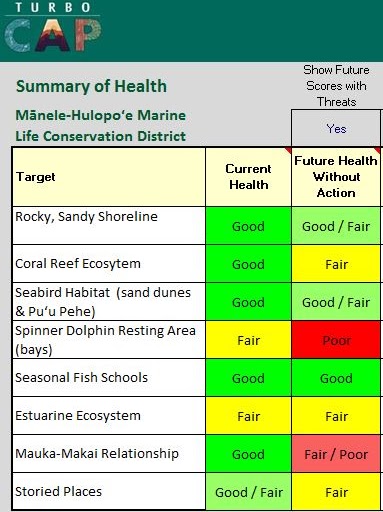
A vital element of Conservation Action Planning (CAP) and the Conservation Standards is identifying key ecological attributes, indicators, and a rating scale to assess the health of conservation targets. Key ecological attributes are broad ecological characteristics that define healthy conditions for a conservation target.
A small number of attributes and associated indicators can provide a reasonable representation of the condition of the target. They also provide a cost-effective way to measure target health on an ongoing basis. By analogy, for assessing cardiovascular health, doctors generally rely on a few important indicators (e.g., blood pressure, cholesterol, BMI) that can be routinely measured over time.
Rating scales help interpret indicators by placing ratings into condition classes (e.g., Very Good, Good, Fair and Poor). Rating scales are refined over time as more information about natural or acceptable variation is better understood. The rating scales are often well-crafted/measurable narrative statements, since well-vetted quantitative measures frequently are not available.
Are We Conserving What We Say We Are? The seminal 2003 Bioscience article introduced a powerful tool to assess conservation targets’ health: identifying key ecological attributes, defining what constitutes viable condition, and providing metrics to rate their health. Key attributes have provided a vital element for Conservation Action Planning, and have been deployed worldwide by project teams to develop hundreds of conservation plans and scorecards for target health. Click here for link.
turboCAP guide to assessing target health A hint sheet and set of simple steps to efficiently develop a set of key attributes, as well as new software developed by Greg Low for health scorecards and conservation planning. Click here for link.